








It is a scene frequently observed in workshops with supply chain leaders: a moment of quiet realization when an executive finally admits, “We’re doing everything we can… but we’re still falling behind.”
The room gets quiet. Everyone knows what they mean. Their teams are working heroically, but the business environment has changed faster than their operating model can adapt.
The truth is, our supply chains were built for an era of stability. Today, they operate in an environment defined by constant volatility, omnichannel complexity, and immense time compression. The core problem we face is that our legacy systems and siloed operating models simply cannot deliver the speed and precision required to compete. The system is outmatched.
This isn't just a feeling; it's a widely recognized reality. In fact, results from the Blue Yonder Supply Chain Compass survey revealed that 82% of respondents agreed that outdated technology will hold back their supply chain performance. The scramble to react is no longer a sustainable strategy. We need a new operating model.
What an agentic supply chain actually means
Let’s be precise. The “agentic supply chain” is not a rebranding of analytics or a collection of disconnected AI pilots. It is a fundamental architectural shift.
In technical terms, the definition is this:
Agentic supply chain is a closed-loop decisioning and execution system where autonomous agents continuously optimize and act across supply chain domains using unified data, shared constraints, and outcome-driven policies.
This moves us from systems that support human decisions to systems that can sense, reason, decide, and execute across the network. Many organizations already use AI for prediction, which answers the question: what will happen? But value is unlocked by decision automation, which answers: what should we do? This is the move from passive dashboards that show you what happened to active "digital workers" that shape what happens next.
This is not experimental. Blue Yonder processes 25 billion AI predictions per day, which proves this is operational at scale, not a theoretical concept.
The operating model: a closed-loop system for execution
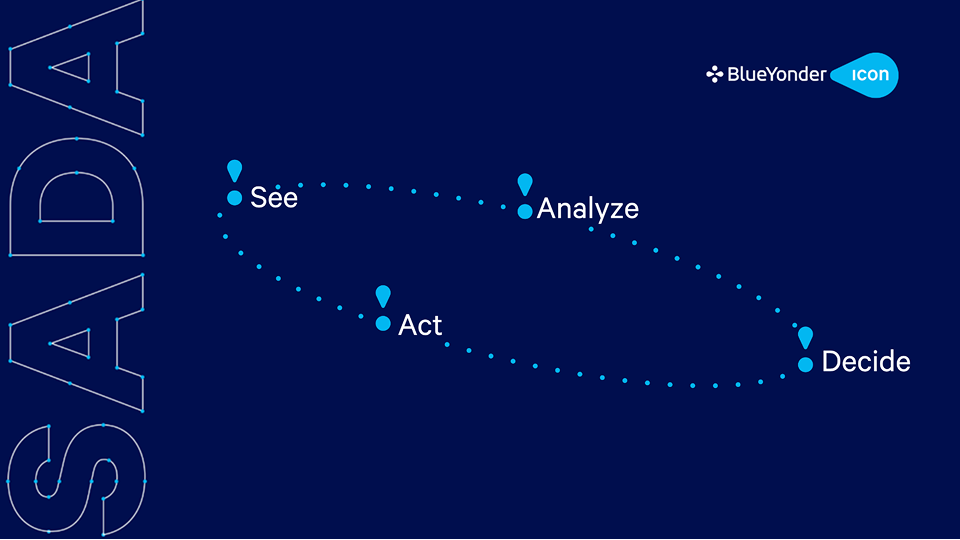
At its core, the agentic supply chain operates on a continuous loop designed for execution, not just recommendation.
- See: This first step involves ingesting a continuous stream of real-time and near-real-time signals from across the network. This includes data on demand, inventory levels, logistics capacity, lead times, disruptions, and active business policies.
- Analyze: Next, the system evaluates the current system state using forecasting, causal diagnostics, anomaly detection, and constraint reasoning. It identifies deviations from the plan and evaluates potential scenarios to understand the implications of various signals and compute tradeoffs.
- Decide: Based on the analysis, the system computes the best possible action. It weighs competing objectives—such as cost, service levels, profit margin, and capacity utilization—using a combination of optimization and AI-driven policy logic to determine the optimal path forward.
Act: This is the critical differentiator. The system doesn't just generate a recommendation for a human to review. It takes direct action to execute the decision within operational workflows, such as triggering a replenishment order, reallocating inventory, changing a sourcing strategy, or adjusting wave planning in the warehouse.
The architectural foundations for autonomy
An agentic supply chain isn't an add-on module; it requires a set of foundational, platform-level capabilities to function safely and effectively.
Unified data and network visibility
Agentic systems cannot operate on conflicting information. They require a single data foundation to eliminate the "phantom inventory" and distorted demand signals that plague siloed environments. This must be a multi-tier network view that provides visibility into suppliers and carriers, reducing the uncertainty that forces companies to carry excess buffer stock. When companies open the supply chain to partners, they can achieve a 30% reduction in inventory.
Unified decisioning
Unified decisioning is the coordination of decisions across both planning and execution to calculate end-to-end tradeoffs. Instead of a merchandising team optimizing for buying cost while a logistics team optimizes for truckloads—often with conflicting results—the system evaluates decisions based on their impact on the entire network. The supply chain becomes a system of decisions, not a chain of departments.
Interoperability for execution
Autonomy fails if a decision, no matter how intelligent, cannot be executed. This requires interoperability, which is far more than just integration. The distinction is critical: Integration moves data. Interoperability moves decisions into execution reliably. It is about ensuring workflow continuity across your WMS, TMS, order management, and partner systems.
Governance and guardrails
To be trusted, autonomy must be controlled. Policy guardrails are the rules that define what autonomous agents are permitted to do. These can include margin thresholds to prevent unprofitable decisions, service tier rules to prioritize key customers, or conditions requiring human approval for certain actions. These guardrails ensure autonomy is both safe and aligned with business strategy.
Explainability and observability
For any organization to adopt an autonomous system, its actions must be understandable. Explainability provides a traceable rationale for why an action was taken—detailing which signals were used, what constraints applied, and which objectives were optimized. Observability provides the tools to monitor agent behavior and measure its direct impact on key performance indicators, tracking everything from action frequency to the impact of policy changes. Together, they prevent the system from ever becoming an operational "black box."
Three concrete use cases in action
1: Inventory availability and waste reduction
The cost of inventory distortion—out-of-stocks and overstocks—is estimated to be $1.7 trillion annually. Agentic execution directly addresses this by coordinating demand sensing, allocation, and replenishment in a single, continuous loop.
In grocery, for example, it intelligently balances the competing goals of maximizing on-shelf availability and minimizing spoilage. It also fundamentally reframes the flow of returns. For many retailers, returns are one of their biggest "suppliers." An agentic system not only speeds the conversion of returns back into sellable inventory but can also inform strategies like encouraging in-store returns to increase foot traffic.