






Today’s supply chain leaders are pushing forward with AI, looking to harness groundbreaking technologies to solve complexity, drive efficiency and uncover new sources of value.
But while the destination for AI is transformational, the route forward has many twists and turns and the milestones are often undefined.
What’s needed is a roadmap—a way for supply chains to assess their progress along the AI maturity curve.
Once they know where they are, they can move confidently from planning to execution to ROI in a methodical cadence, with clear objectives in sight.
With that goal in mind, we’ve created an AI maturity model that outlines how specific AI technologies can be implemented at each stage of development, the benefits they provide and how they stack to enable the next level of maturity.
We focus on answering the following questions:
- How can we maximize the value of the tech at this particular stage?
- When have we achieved full implementation?
- What’s the next move?
Let’s get started!
Stage 1: Automation
Optimizing operations for a turbulent business environment
The first step toward AI maturity and the foundation of AI success—is process automation.
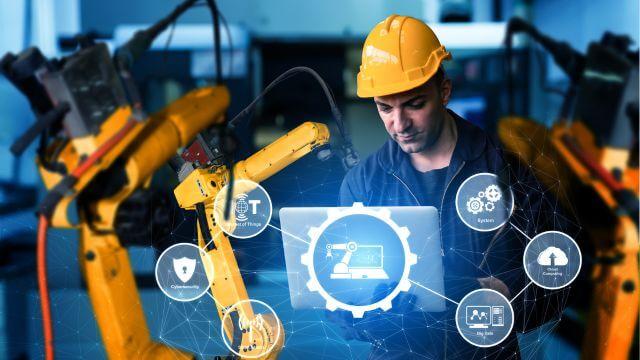
In this stage, supply chains leverage technologies like digital supply chain management platforms, robotics, and IoT sensors to execute administrative workflows and physical tasks with minimal human intervention.
For example, in the warehouse, inventory management systems analyze inventory levels in the context of supply and demand pressures; meanwhile, on the warehouse floor, autonomous shelf loaders and robotic forklifts work alongside human workers.
Amid today’s landscape of constant disruption, automated workflows are invaluable. They increase the speed, reliability, accuracy, and efficiency of supply chain operations.
The goal of Stage 1 is to maximize the effectiveness of existing processes while crucially, generating a robust set of operational data. This data enables the next stage of the maturity curve because AI requires data to activate.
You’ll know that this stage is complete, when targeted automations are up and running effectively—keeping in mind that it may take some time to determine which automation investments deliver a real return. Once the new system has generated a usable data set for AI, you are ready to move to Stage 2.
Stage 2: Predictive/Analytic AI
Shifting from reactive to proactive supply chain management
Once supply chain operations go cloud-native, they can then support an analytic layer that drives proactive decision-making.
Analytic or predictive AI uses statistical analysis and machine learning (ML) to comb through operational data, identifying patterns and correlations that are used to anticipate disruptions and prompt swift action to manage risks.
For example, AI algorithms can analyze market trends, weather patterns, and social media signals to predict customer demand with a high degree of precision.
With predictive AI in place, supply chains are ready for disruptions before they happen. As you can imagine, this revolutionizes demand forecasting, inventory management, logistics optimization, predictive maintenance, risk scoring, and contingency planning.
Once AI analytics are humming, supply chains will have achieved deep visibility into operations, breaking down information silos and understanding how actions reverberate across supply chain functions. With Stage 3, it’s time to put this information into action.
Stage 3: Generative AI
Accelerating execution and making room for strategic decision-making
Now, AI moves from analysis to execution.
Generative AI synthesizes unstructured data to create new content, automating and streamlining supply chain processes that require communication, summarization, or research.
For example, generative AI can play an important role in vendor management. The AI scans lengthy vendor agreements instantly, summarizing legal risks, payment terms, and compliance liabilities. It also works in the other direction, drafting detailed, context-aware emails to vendors based on preset parameters. And when invoicing discrepancies or shipping delays arise, the AI helps you research and resolve them in a fraction of the time it would take with manual processes.
Besides the obvious time savings, generative AI relieves staff from the pressure of completing tedious tasks, giving them more room to think strategically.
Stage 3 is complete when generative AI has become fully integrated into daily operations—when staff have full confidence in the accuracy of AI and have come to depend on it to maximize their reach.
At this point, AI is no longer just suggesting "what" is happening, but is consistently providing the "why" and a viable "how-to" for complex problem-solving. Now you are ready for Stage 4.
Stage 4: Agentic AI
Capturing value for the enterprise at scale
In Stage 4, AI evolves from a human-dependent tool to an autonomous collaborator.
AI agents are systems that can plan and execute multi-step tasks independently, without direct human supervision, to achieve high-level goals.
For example, a logistics agent might be deployed to anticipate and manage shipping disruptions. When a carrier has a problem, the agent can re-route the shipment, negotiating a spot rate with a different carrier, and update the customer—all without instruction from a human.
But these agents are much more than just a robotic “employee.” They actually change the way a business operates, uncovering hidden value by continuously analyzing massive datasets to find operational efficiencies and revenue opportunities at a systems level.
At first, AI agents are usually deployed for one-off functions; this stage is complete when agents are deployed across the supply chain. Successful agentic supply chains generate business insights that human managers can use to develop and deploy new value strategies in a continuous feedback loop.
Stage 5: Customized AI
Widening the moat and taking the lead
Once an organization has mastered AI, it becomes part of the business’s DNA—AI becomes truly native.
At this stage, supply chains start creating bespoke AI use cases that grow revenue, increase supply chain resilience, and build a competitive moat within their specific sector and regional context.
For example, a fashion retailer—whose business model relies on staying ahead of fast-changing tastes among young consumers—builds an AI system that analyzes real-world data to identify fashion trends before they emerge in the mainstream. Their supply chain is built to respond to this analysis in real-time, shifting production in a matter of days, if necessary.
With this kind of hyper-customization, the supply chain actually becomes stronger and more profitable during market volatility because AI identifies arbitrage and revenue opportunities that competitors simply cannot see.
With Stage 5, the supply chain has fully transitioned from cost center to growth engine, leading the business.
The journey to AI maturity starts with a single step
The possibilities for AI are dizzying—and that can be overwhelming. For many supply chain leaders, it is hard to know where to start, where technology investments can have the most impact, and how to measure success.
But uncertainty should not be an impediment to action. Assess where you are, make a plan, and take action. Every step forward represents more value being unlocked.
