Accelerate Informed Decisions With AI Built for Supply Chain
Built on decades of supply chain innovation and AI expertise, our predictive, generative and agentic AI solutions turn raw data into predictions and guidance that help your teams navigate this complexity.
Demystifying AI for Supply Chain Leaders
The benefits of artificial intelligence for supply chain leaders are obvious, but the implementation isn't always as straightforward. Learn why (and how) your company should prioritize AI solutions now.
Reorganizing for AI: How Supply Chain Leaders Have to Adapt
90% of supply chain leaders are currently executing a reorganization or will do so in the next 12 months. Many are preparing their teams for AI-driven supply chain technology, but how should they adapt and reorganize for an AI-first future?
DHL saves 7% on transportation costs through better optimization of vehicles and stops with Blue Yonder Network Design
Carlsberg Group
Carlsberg shares how the company is going digital first using Blue Yonder's Transportation Management, the company's “Zero & Beyond” strategy and more.
Walgreens
Blue Yonder’s AI-based Order Management provides the ‘Magic’ behind Walgreen’s 30-minute customer order promise.
How AI-Enabled Planning Will Improve Your Supply Chain Performance
Extreme volatility, inventory shortages and data overload are all challenges businesses are facing when it comes to supply chain planning. AI-enabled planning capabilities can address these challenges by improving decision-making, agility, and collaboration across supply chain functions.
2026 Supply Chain Compass: How Supply Chain leaders are navigating complexity
The Supply Chain Compass 2026 report surveys nearly 700 supply chain leaders, exploring how they are navigating a rapidly evolving landscape shaped by AI, disruption, and rising expectations. While nearly half express strong optimism about the future, the report reveals that this confidence is driven by greater visibility, stronger technology adoption, and more integrated, data-driven supply chain strategies.
Beyond Silos: Evolving to an Enterprise Supply Chain
Incisiv explores the significant transformation underway in modern supply chains, detailing the shift away from fragmented processes and point solutions to more agile platforms and collaborative workflows. This evolution addresses systemic issues such as inflexibility and disconnected communication, enhancing supply chain responsiveness, sustainability, and profitability.
Carbon accounting might sound complicated, but it’s becoming an essential part of every company’s procurement process. As the push towards sustainability accelerates, understanding your carbon footprint isn’t just a “nice to have” anymore—it’s something your business strategy should be built around.
In this post, we’ll walk you through the basics of carbon accounting, especially from a logistics manager’s point of view. You’ll get a clear picture of what carbon accounting means, why it matters, and how to put it into practice. We’ll go step by step—from calculating emissions to reporting them—and share practical ways to make the process easier for you, your team, and your logistics partners.
By the end, you’ll know how to stay compliant with new regulations and position your company as a sustainability leader—giving you a real edge in today’s competitive market.
Section 1 – The basics of carbon accounting
What is carbon accounting?
Carbon accounting is the process of tracking and managing how much your business contributes to climate change. As companies become more aware of their environmental impact, carbon accounting has become essential for measuring and reducing greenhouse gas (GHG) emissions.
By gathering the right data, you can uncover where your emissions come from, find ways to cut them down, and strengthen your company’s sustainability profile, while meeting disclosure and compliance requirements.
You can think of carbon accounting a bit like financial accounting. Just as you track income and expenses to understand your financial health, carbon accounting helps you track your emissions to understand your environmental footprint.
Ultimately, it’s a powerful way to see where you stand, save costs, and lead the way toward a more sustainable future.
What are Greenhouse Gases (GHG) emissions?
When greenhouse gases are released they trap heat in the Earth’s atmosphere. That trapped heat causes global warming, which gradually makes the planet harder for people to live on.
Here are the key greenhouse gases and where they come from:
Carbon dioxide (CO₂) — from burning fossil fuels, deforestation, and many industrial processes.
Methane (CH₄) — from livestock digestion, landfills, and fossil-fuel extraction.
Nitrous oxide (N₂O) — from agricultural fertilizers, manufacturing, and fuel combustion.
Hydrofluorocarbons (HFCs) — from refrigerants, air-conditioning, and aerosol sprays.
Perfluorocarbons (PFCs) — from aluminum production and electronics manufacturing.
Sulfur hexafluoride (SF₆) — from electrical insulation and circuit breakers.
Nitrogen trifluoride (NF₃) — from semiconductor and flat-panel display manufacturing.
Not all greenhouse gases behave the same way. Some stay in the atmosphere only for a few years, while others hang around for centuries. They also absorb heat differently — which means some have a much bigger impact on the environment than others. That’s why figuring out your company’s total GHG emissions, or carbon footprint, isn’t always straightforward.
What is carbon footprint and how is it calculated?
A carbon footprint is the total amount of greenhouse gases released into the atmosphere, either directly or indirectly, by a person, organization, or product. It measures the environmental impact of our everyday activities.
Carbon footprint reflects all the GHGs produced through your operations. That includes emissions from things like energy use, transportation, and waste, as well as those tied to the goods and services you purchase from others.
And even though it’s called a carbon footprint, it actually covers all types of greenhouse gases. To make it easier to measure, everything is converted into a single unit called carbon dioxide equivalent (CO₂e)—which helps you compare and track your total impact more clearly.
What do supply chain leaders think about sustainability?
One thing was clear from the 2025 Supply Chain Compass report: executives are concerned about their sustainability efforts. See how companies are building the business case for long-term sustainability strategies in our spotlight report.
What is carbon footprint and how is it calculated?
A carbon footprint is the total amount of greenhouse gases released into the atmosphere, either directly or indirectly, by a person, organization, or product. It measures the environmental impact of our everyday activities.
Carbon footprint reflects all the GHGs produced through your operations. That includes emissions from things like energy use, transportation, and waste, as well as those tied to the goods and services you purchase from others.
And even though it’s called a carbon footprint, it actually covers all types of greenhouse gases. To make it easier to measure, everything is converted into a single unit called carbon dioxide equivalent (CO₂e)—which helps you compare and track your total impact more clearly.
What is CO₂e?
While CO₂ (carbon dioxide) is a specific greenhouse gas that naturally exists in the atmosphere, CO₂e (carbon dioxide equivalent) is a standardized way to measure the total impact of all greenhouse gases combined. It expresses their effect in terms of the amount of CO₂ that would cause the same level of warming.
To calculate the CO₂e of any greenhouse gas, you need to know its Global Warming Potential (GWP)—which tells you how much heat that gas traps in the atmosphere compared to CO₂, usually measured over a 100-year period.
CO₂e lets you compare and combine different gases on the same scale, making it easier to understand overall climate impact.
How do you calculate CO₂e?
To calculate the CO₂e of any greenhouse gas, you can use this simple formula:
CO₂e = Amount of a particular GHG × Its Global Warming Potential (GWP)
Here’s an example: If your operations produce 0.5 tonnes of methane, and methane has a GWP of 28, the calculation would look like this:
0.5 × 28 = 14 tonnes CO₂e
This means your methane emissions are equivalent to releasing 14 tonnes of carbon dioxide into the atmosphere.
To find your total carbon footprint, you’ll need to do this for every greenhouse gas your business produces — multiply each by its GWP, then add them all together to get your overall CO₂e.
Keep in mind, some gases have very high GWPs — for example, certain hydrofluorocarbons (HFCs) and sulfur hexafluoride (SF₆) can have values in the tens of thousands. That means even a small amount can significantly increase your carbon footprint.
Understanding sources of carbon emissions in your business
What are scope 1, 2 and 3 emissions?
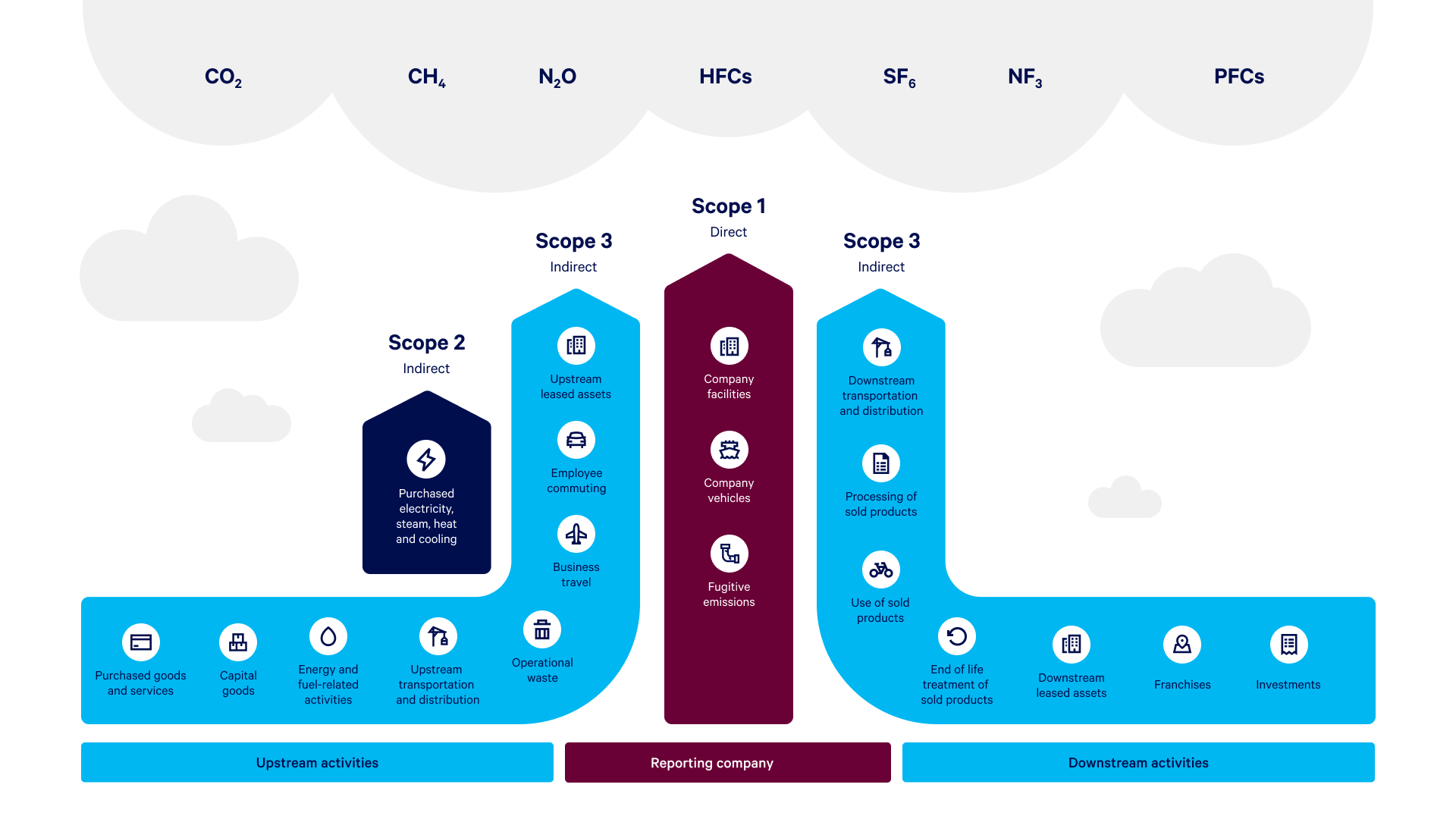
According to the Greenhouse Gas Protocol (GHG Protocol), a company’s emissions are grouped into three categories, or “scopes.” These help businesses understand where their greenhouse gas (GHG) emissions come from. Whether they’re produced directly or indirectly as part of operations.
Here’s a quick breakdown:
Scope 1: These are direct emissions from sources that your company owns or controls.
Example: Fuel burned by company vehicles or emissions from manufacturing equipment.
Scope 2: These are indirect emissions from the energy your company purchases and uses.
Example: Emissions from the generation of electricity, steam, heating, or cooling that your business consumes but doesn’t produce directly.
Scope 3: This covers all other indirect emissions that happen across your value chain—beyond Scopes 1 and 2.
Example: Emissions from suppliers producing materials for your business, transportation of goods, or even the use and disposal of your products by customers.
Together, these three scopes give you a full picture of your company’s carbon footprint—from the emissions you control to those connected to your wider network.
As a logistics manager, most of your reporting work falls under Scope 3, since it includes transportation, warehousing, and distribution activities.
Scope 3 emissions: A deep dive
Scope 3 emissions cover all the indirect emissions that happen across your company’s entire value chain. Because it includes so many different activities, Scope 3 can feel a bit overwhelming — it’s not always clear which emissions fall under it.
But here’s why it matters: Scope 3 accounts for nearly 60% of all global emissions. That means addressing them offers the biggest opportunity to make a real impact.
To make things easier, the Greenhouse Gas Protocol (GHG Protocol) breaks Scope 3 into 15 categories in its Scope 3 Calculation Guidance. These categories are split into two groups. Upstream (before your operations) and downstream (after your operations):
Upstream:
1. Purchased goods and services
2. Capital goods
3. Fuel and energy-related activities not included in Scopes 1 or 2
4. Upstream transportation and distribution
5. Waste generated in operations
6. Business travel
7. Employee commuting
8. Upstream leased assets
Downstream:
9. Downstream transportation and distribution
10. Processing of sold products
11. Use of sold products
12. End-of-life treatment of sold products
3. Downstream leased assets
14. Franchises
15. Investments
As a logistics manager, your main focus will likely be on categories 4 and 9—the emissions from transportation, storage, and distribution of goods, both upstream and downstream of your company’s operations.
Scope 3 calculation methods in carbon accounting
Now that you know what carbon accounting involves and which emission sources to look at, the next question is — how do you actually measure your Scope 3 emissions?
The answer depends on the kind of data you have and how your value chain is set up. In general, there are three main methods you can use to calculate Scope 3 emissions:
1. Spend-based method
2. Activity-based method
3. Supplier-specific method
Spend-based calculation
The spend-based method works by taking the financial value of the goods or services you’ve purchased and multiplying it by an emission factor. Basically, the average amount of emissions produced per dollar spent. It’s a simple and quick way to estimate emissions, especially if detailed data isn’t available. However, it’s also less accurate because it uses general averages and doesn’t reflect the specific characteristics of each product.
Activity-based calculation
Instead of using financial data, this method relies on the physical quantity of materials (like weight) multiplied by the relevant emission factors. It’s generally more accurate than the spend-based method, but since it still uses averages, it may not always provide a high level of precision.
Supplier-specific calculation
This is the most accurate method, as it uses direct data from suppliers. It involves collecting detailed information such as energy use or raw material sourcing from your suppliers so you can calculate emissions based on actual activities within your supply chain. While this approach provides the most precise insights, it can be time-consuming and complex because of limited transparency across global supply chains.
Hybrid approach
In practice, companies often start with the spend-based method because it’s easier to implement, then gradually move to more accurate methods as better data becomes available. Many also use a hybrid approach, combining supplier-specific data where possible and filling in the gaps with spend-based or activity-based estimates.
Section 2 – Carbon accounting in your logistics supply chain
Carbon accounting within your logistics supply chain is about tracking, managing, and reporting the emissions that come from your logistics operations—even when those activities are handled by third parties. It requires close coordination with your logistics partners, such as freight forwarders, who play a key role in providing the emissions data linked to your shipments.
In this section, we’ll break down logistics carbon accounting into three main steps to help you understand how it works and where to begin.
Step 1: Calculating emissions
The first step is to convert your shipment data into GHG emissions data. This is usually handled by your logistics providers, who perform the calculations before sharing the final results with you. Still, it’s important to understand how this process works so you can clearly communicate your requirements and expectations to your suppliers during the calculation phase.
Introducing the GLEC Framework
The transport and logistics industry follows a well-defined methodology for calculating GHG emissions from freight activities. This framework helps you and your suppliers measure and report your business’s Scope 3, Category 4 and 9 emissions — those linked to transportation and distribution.
Importantly, the GLEC Framework is the only internationally recognized methodology for measuring and reporting carbon emissions from freight transport. It also forms the foundation for the ISO 14083 standard, which sets out how to quantify and report GHG emissions from transport chain operations.
How does the GLEC variFramework work?
The GLEC Framework allows for different levels of precision depending on the quality and detail of the data you provide. At the most basic level, it uses only essential shipment details to estimate emissions. At the most advanced level, it draws on actual data from the specific vehicles used to transport and distribute goods.
It defines three main data input types for calculating emissions:
1. Default data:
This method relies on standard industry averages and assumptions — outlined in the Smart Freight Centre’s End-to-End GHG Reporting Guidance — to estimate emissions when only limited data is available, such as cargo weight, distance traveled, and an emissions intensity factor. Because it accounts for many unknowns, this approach tends to be conservative and often slightly overestimates actual emissions.
2. Modelled data:
Modelled data builds on default data but adds more detailed, vehicle- and route-specific information. This type of data is typically available through specialized carbon accounting software. It can include details like vessel IMO numbers, carrier codes, or flight numbers, which allow you to apply emissions factors for the exact vehicle used. It can also factor in road type, route gradient, and traffic conditions — resulting in a more accurate estimate.
3. Primary data:
This is the gold standard for Scope 3 carbon accounting in transport and logistics. It uses actual records—such as fuel receipts or digital fuel consumption data—from the vehicles that moved your goods. While it delivers the highest accuracy, it’s often the hardest to obtain due to the complexity and opacity of global supply chains.
Understanding these three data input types helps you assess the quality of the emissions calculations your logistics providers share with you—and set a clear minimum data standard when engaging them for tenders or partnerships.
Step 2: Supplier data collection and management in logistics carbon accounting
Accurately calculating GHG emissions from your logistics supply chain requires strong data management since much of the information you’ll need will come from your suppliers. This adds an extra layer of complexity to collecting and managing your Scope 3 emissions data.
Challenges of logistics emissions data collection in carbon accounting
Differing levels of carbon reporting awareness: Not all logistics providers have the same level of understanding or capability when it comes to calculating and reporting shipment carbon emissions. This can lead to inconsistencies in data quality. Smaller suppliers, in particular, may not have the resources or expertise needed to provide accurate emissions data.
Variability in reporting standards across regions: Because carbon emissions reporting is still a relatively new practice, reporting standards can vary widely from one region to another. This makes it challenging to combine and present your carbon emissions data in a consistent, comparable format.
Varying data sources: When different suppliers use different tools or methodologies to calculate and report shipment emissions, it becomes difficult to make accurate comparisons or identify reliable carbon emissions sources. This often results in fragmented or mismatched datasets.
Engaging with your suppliers during the carbon accounting process
To help address these challenges, engaging closely with your suppliers should be a key part of your carbon accounting process. From the very beginning of any contract, clearly outline your expectations for Scope 3 emissions reporting, including the reporting standards they must follow, how and when reports should be submitted, and any penalties for missing deadlines or failing to comply.
It’s also important to ensure that suppliers use a science-based methodology, such as the GLEC Framework when calculating emissions. This gives you confidence in the accuracy of their data and helps maintain consistency during your reporting phase.
When working with new suppliers, make sure to vet them thoroughly on their carbon emissions calculation and reporting practices. Ask about the tools and methods they use, confirm that their reports meet your data requirements, and ensure they can deliver information in the right format for your records.
Just like financial due diligence, carbon emissions reporting due diligence should become a standard part of your procurement process. This ensures that your suppliers’ reporting capabilities align with your sustainability goals and support your journey toward more transparent, accurate emissions tracking.
Your true north for supply chain insights
Global trends and industry insights, delivered monthly with the Supply Chain Compass Newsletter.
Step 3: Carbon reporting in your logistics supply chain
Another key part of the carbon accounting process is carbon reporting. The GHG Protocol outlines clear guidance on how businesses should report their emissions in its Corporate Accounting and Reporting Standard. According to this guidance, your data must be accurate, transparent, and well-documented to build stakeholder trust and comply with climate disclosure regulations such as the EU’s Corporate Sustainability Reporting Directive (CSRD).
Formatting carbon reports
Categorizing emissions: Report your emissions by scope and category, and include the total emissions for each. This breakdown helps stakeholders see where your emissions come from and identify opportunities for reduction.
Justifying exclusions: If you’ve excluded any categories or activities from your report, clearly explain why. This could be due to missing data or because the excluded activities have an insignificant impact on total emissions.
Explaining calculation methods: List and describe the calculation methods and data input types used for each category. Being transparent about your methods allows stakeholders to assess the credibility of your report and understand how your emissions figures were determined.
Data quality and documentation
An important part of good carbon emissions reporting is showing how reliable your data is. Including a clear data quality indicator (DQI) helps stakeholders understand how accurate your emissions calculations are and how much they can rely on them when planning reduction strategies.
Each report should include a DQI that rates the quality of data used in the emissions estimate at a detailed level. Providing a DQI isn’t just best practice — it’s also part of meeting the ISO 14083 standard.
Third-party verification
Third-party verification is another crucial step in the carbon reporting process. Having your report reviewed by an independent assessor ensures that it meets required standards and is free from errors or bias. The process typically covers:
Compliance: Verification bodies check that your report follows the GHG Protocol and any other relevant guidelines. This step is especially important for companies that must meet mandatory climate disclosure requirements such as the CSRD.
Credibility: Independent verification strengthens the credibility of your report, giving stakeholders confidence that your emissions data is accurate and trustworthy.
Risk mitigation: Verification also helps detect and correct any potential issues before your report is published, lowering the risk of fines or penalties for non-compliance with regulations.
Reporting for climate disclosure regulations
With climate disclosure regulations now in effect, businesses need to be especially diligent about their carbon accounting practices—particularly during the reporting phase. For instance, the Corporate Sustainability Reporting Directive (CSRD) requires companies to provide detailed, standardized climate disclosures that include carbon emissions data across all three scopes.
Failing to comply or submitting inaccurate reports can lead to significant fines and damage your company’s reputation. To avoid these risks, make sure your reporting process fully aligns with the climate disclosure regulations that apply to your business. Pay close attention to data accuracy, report formatting, and verification requirements to ensure your reports meet the highest standards of compliance and transparency.
Section 3 – Carbon accounting software
Carbon accounting can feel overwhelming—especially when you’re under pressure to meet climate disclosure requirements or report to stakeholders. Fortunately, there are specialized carbon accounting software solutions available that can make the process much easier. These tools help streamline every stage of carbon accounting, simplifying complex tasks like data collection, calculation, and reporting.
The benefits of carbon accounting software
Provide accredited carbon emissions calculations
Carbon accounting software allows your logistics providers to convert raw shipment data into accurate emissions estimates using industry-recognized methodologies such as the GLEC Framework. When collaborating with logistics partners, make sure they use GLEC-accredited solutions so you can trust the accuracy and consistency of the emissions data they provide.
Enhanced data collection
Once your suppliers have converted shipment data into emissions data, carbon accounting software can seamlessly transfer that information into your systems, greatly improving the efficiency and accuracy of data collection. Instead of relying on manual, time-consuming email exchanges that often lead to errors or missing details, your suppliers can directly upload their data into the platform. Automating this process ensures you have a reliable, complete, and up-to-date dataset.
Simplified scope 3 management and analysis
Carbon accounting software gives you a complete view of emissions across your entire supply chain, helping you spot trends, patterns, and key areas for improvement through easy-to-use dashboards and analysis tools. Features like the Data Quality Indicator (DQI) ensure that all collected data is standardized and comparable. You can use these insights to identify emissions hotspots within your supply chain, make more informed decisions, and take a more strategic approach to setting and achieving your carbon reduction goals.
Streamlined emissions reporting
At the final stage of the carbon accounting process, carbon accounting software can simplify and streamline your reporting activities. It allows you to quickly generate reports formatted to meet climate disclosure regulations or your company’s ESG reporting requirements. These tools also make it easier to share reports, reducing administrative workload and minimizing the risk of reporting errors.
Section 4 – How logistics managers can get started with carbon accounting
If you’ve read this far, you’ve already taken the first step. Here’s how to build a solid foundation for carbon accounting in your organization.
1. Build your knowledge
The first step in carbon accounting is understanding the fundamentals. Get familiar with how carbon accounting works and identify what it means for your business specifically. While this blog covers the basics, it’s worth diving deeper into key topics to strengthen your understanding. Here are a few trusted resources to get you started:
Once you have a solid grasp of the basics, start exploring different carbon accounting software solutions. There are plenty of options out there — some built specifically for supply chain logistics, others designed for broader business needs. Take time to compare tools and see which ones best fit your operations. If you’re focusing on logistics, make sure the tool you choose is GLEC-accredited and ISO 14083-aligned to ensure data accuracy and compliance.
3. Engage your suppliers
Bring your suppliers into the process early. Many freight forwarders and logistics service providers may not yet realize that their shippers will soon be required to manage and report carbon emissions. Let your current providers know about your plans and explain how they can support you. You should also make carbon reporting a core part of your procurement process, so any new suppliers you work with meet your reporting standards right from the start.
What’s next once you've established a carbon accounting process?
Carbon accounting is just the beginning of your business’s journey toward decarbonization — but it’s a crucial first step that every organization needs to take.
Once you’ve established and refined your carbon accounting process, you’ll be in a strong position to pinpoint emissions hotspots and uncover opportunities to reduce emissions across your logistics supply chain.
Reduce carbon emissions and waste across your supply chain
Blue Yonder Sustainable Supply Chain Management provides accredited reporting, real-time insights, and powerful optimization engines to reduce waste and carbon emissions throughout the supply chain.