
AI and cost optimization

Blog

AI and cost optimization

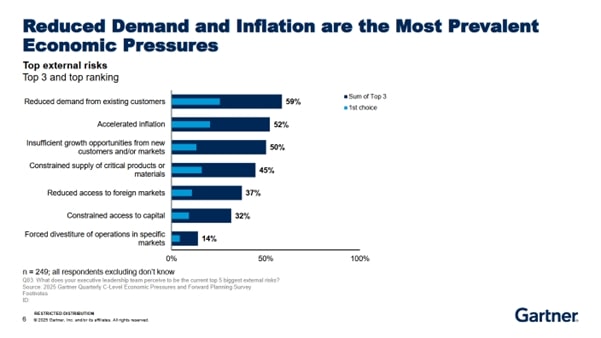
Supply chain leaders are facing pressure to reduce costs. All kinds of business are facing headwinds. “60% of executive team leaders do not perceive the environment to be favorable to company performance,” according to Gartner®, with reduced demand from existing customers and accelerated inflation their top two risks.
ai-and-cost-optimization-body-01

When asked in the Blue Yonder Supply Chain Compass survey about their biggest concerns, 28% of supply chain leaders explicitly mentioned rising costs, with retailers most likely to have this as their main concern (35%). It’s not surprising then that 63% of leaders surveyed said that managing supply chain costs is a key action for achieving their strategic goals this year.

However, many of the costs incurred in supply chains are structural and can be hard to change in the short or even medium term. That puts even greater pressure on the areas of supply chain management that can be optimized to become maximally efficient and cost-effective.

We know that AI is already changing how supply chains work, and that the scale, precision and speed at which AI can operate should drive efficiency and value across the end-to-end supply chain. So where do supply chain leaders see AI driving costs down, and what role does AI play in cost optimization strategies?

Priority differences

We can look at how strategic priorities differ between those leaders who told us that managing supply chain costs is a critical action and those who did not.
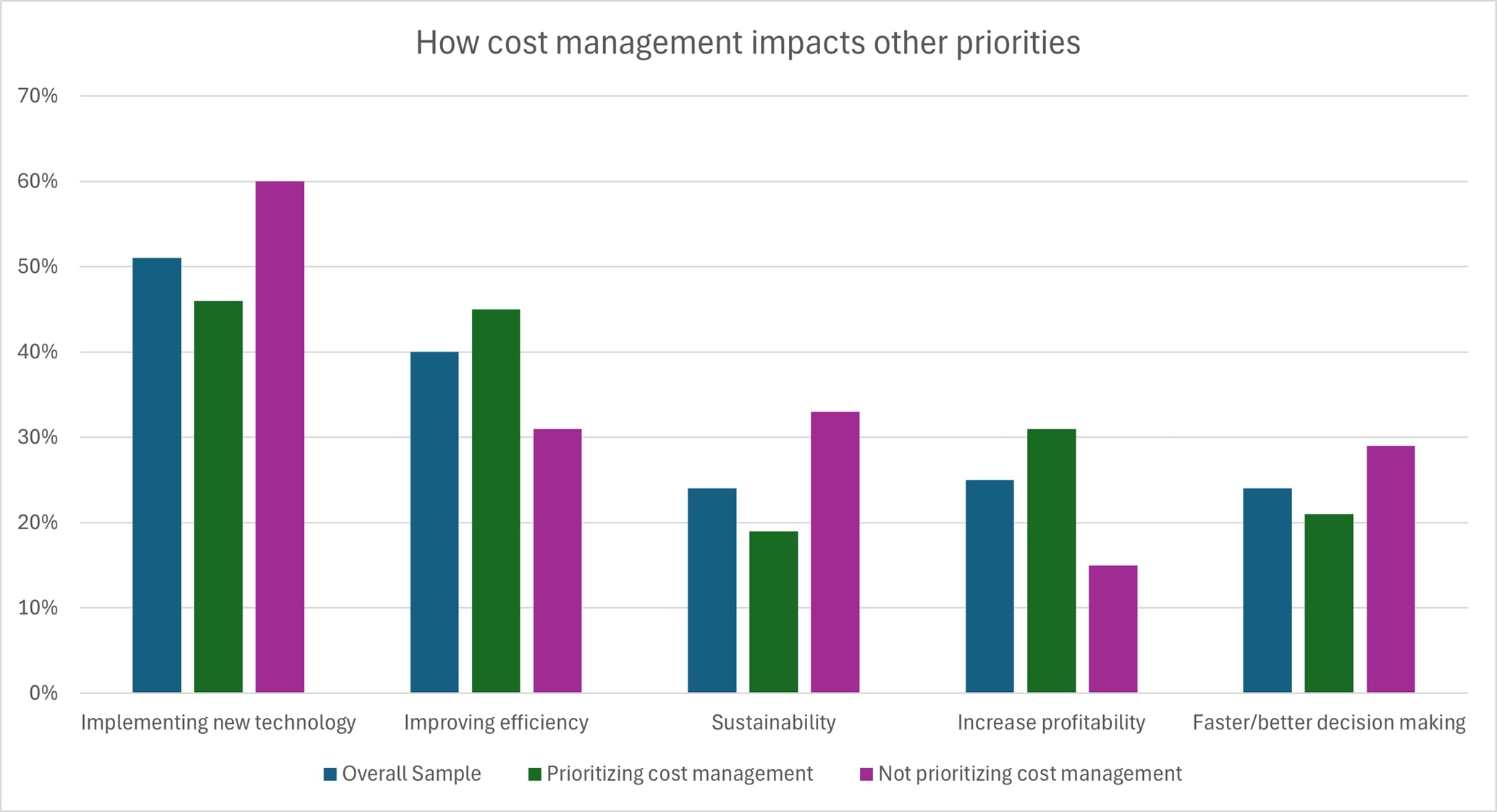
Chart showing leaders focusing on cost management deprioritise sustainability, decision-making and implementing new technology

There’s an obvious logic to cost managers prioritizing profitability and efficiency more often than those who are less concerned with cost reduction. Implementing new technology can come with serious upfront costs, so it’s not surprising that this might be a lower priority for those managing costs. However, it seems at first glance that by deprioritizing new tech implementation, sustainability and faster/better decision making, leaders might fall into a trap.

The risk is that in an effort to keep costs lower in the short term, supply chain leaders don’t make the right investments to build intelligent, agile supply chains—those which can deliver long-term efficiency and profitability.

But that’s a risk these leaders seem very cognizant of. 83% agree that outdated technology will hold their supply chain back, and only 5% are confident in achieving their goals without upgrading their current technology stack. 
 

The role of AI


ai-and-cost-optimziation-body-03

With leaders having budgeted to invest in technology to overcome siloed decision making (67%), speed up decision making (49%) and make complex changes to business models (53%), it’s clear that technology investment is firmly on the agenda. To make that compatible with increasing focus on cost, 72% of leaders are seeking ROI quickly, within a year.   

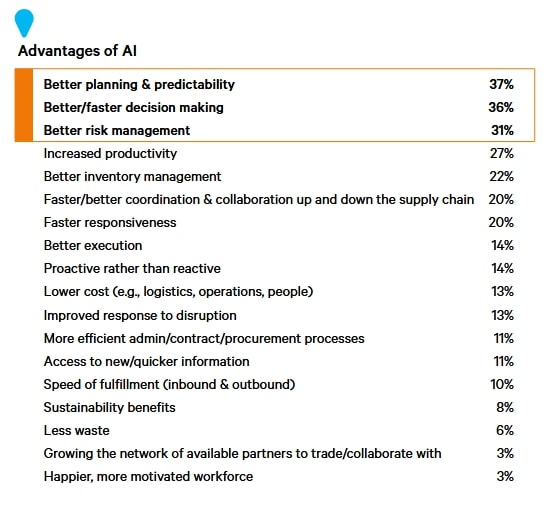
The advantages they see from AI aren’t directly cost-related. Just 13% of leaders said that lowering operational costs was an advantage of AI. What they’re seeking is a supply chain that becomes faster, more efficient and more resilient, to drive greater value for their business. 

This is critical in understanding how supply chain leaders are approaching cost optimization and reduction. 
It is not a flat cost-cutting exercise where technology investment falls in line with reduced budgets across the board. 
Instead, AI enables supply chains to become more valuable, greater differentiators of success for businesses, with myriad benefits depending on the emphasis leaders place on strategic priorities.

Clearly, many of these advantages have an immediate cost implication, even if cost reduction is not the only goal. It’s being adopted not primarily to drive down costs, but to realize the maximum value of supply chain operations.  

Adoption challenges

ai-and-cost-optimziation-body-04

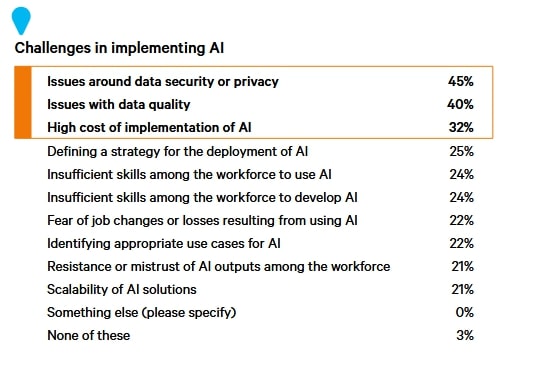
The biggest barriers to wider AI adoption are data quality and security. For AI to be effective in any given area of supply chain, it needs quality data and strategic alignment across areas—note that a quarter of the sample found AI deployment strategy a barrier to implementation. 

The deepest machine learning algorithms and most intelligent agentic tools will not be able to transform a business where departments aren’t aligned, where data is inaccessible and out of date, where there are existing conflicts of interest.

In addressing this, the need to rationalize costs across a supply chain may offer an opportunity for leaders. To really effectively reduce costs, a business needs a single source of truth. To quickly get the most out of AI and intelligent supply chain technology, a business needs a single source of truth. A unified data model on the cloud enables both.

AI is a valuable tool for cost optimization (and much else)

In an environment where all the controllable costs have to be minimized, investment in technology seems unlikely. However, supply chain leaders broadly recognize that the point of the exercise is not to simply reduce expenditure, but to maximize value from that expenditure. In that context, investing in AI supply chain solutions becomes more, not less, of a priority.

That’s because not only does AI have the potential to reduce costs in the short term, by making better planning decisions and optimizing operations. It is also a necessary transformation for supply chains to be able to withstand future disruptions and offer competitive advantages. 

Discover how Blue Yonder AI transforms supply chains

Built on decades of innovation and AI expertise, our predictive, generative, and agentic AI solutions turn raw data into predictions and guidance built for the supply chain.